Indus valley civilization is the civilization of Jain race – From 4000 B.C onwards.
The Indus valley civilization is the work of the North Western Jains (2 million people), and not of 1.7 billion people of Indian sub – continent.
1.Jains have the highest IQ (120) in the world as they underwent maximum human evolution, and the highly and most advanced Indus valley civilization of the ancient world would have been the work of extremely High IQ people. The traits of Jainism and Jain people, is a reflection of the extremely High IQ genetics of Jains.
2.The below is a geographical spread of the Jain community which matches close to the spread of Indus valley civilization.
The continuous invasions from the West and North would have forced Jains to move more East and South from the wider spread of IVC.
There are pockets in Maharashtra and South India having Jain population but which are of later stage influences and conversions from other castes, and don’t belong to the same community as that of North – Western Jains (unless they are migrant groups). The other non – native Jain community in South India is that of Bunt community but almost all had been into Hinduism later on. The Bunts had accompanied Jain monks in their ascetic journey to South India from North West India at a time in history and had converted to Jainism before being converted into Hinduism. Jains left their impact culturally in Karnataka and Tamil Nadu including through food items like ‘Idli which is derived from ‘Idada’ also known commonly as Gujarati ‘Dhokla’ , and its batter derivation – dosa and medu vada, all of which is passed on as ‘South Indian cuisine’.
North Western Jains had a presence in Indus river base in Sindh even during the invasion of Alexander, as recorded by Greek history, and Jainism had influence extending to middle east in the ancient world with having Alexander befriended and taken Jain monks back with him to Greece. Some abandoned Jain temples remain in Sindh now Pakistan region but they are of recent times in history.
There are few thousand ethnic Punjabi speaking Jains (Bhabhra Jains who were later stage converts) also left today. They migrated from Multan region in Punjab, now in Pakistan after Partition of India.


3.Jain scripture traces the history of Jains back to their time living during the phase of Indus valley civilization, and Jainism has been designed as such, to survive the Decaying times of ages which began from the the time of Jains residing during their stay during Indus valley civilization timeframe. Jainism is the oldest organized religion of the world, which is based on being eternal. Human civilization was a project of the Jains, and both the Eastern civilization and Western civilization is the work of Jains.
Jainism was the religion of the Indus Valley civilization (3500 B.C – 1500 BC) making it the first organized religion of India. India was called as ‘Bharat’ and is still referred as such in its native tongue, is named after the son of 1st Tirthankar of Jainism of the current cosmic cycle– Adinath/Rushabdev of timeframe 2500 B.C. Before Tirthankar Rushabdev was Tirthankar Samprati of the previous time cycle of the era of around 3000 B.C. Bharat can be considered as the 1st prominent ruler of India of around 1800 B.C , and that there was no other organized religion present in India before his rule.
To summarize :
Tirthankar Samprati – Reigned around 3000 B.C
Tirthankar Rushabdev – Reigned around 2500 B.C – 2000 B.C
Bharat – reigned around 1800 B.C
According to Jain scriptures, Tirthankar Rushabdev’s daughter – Brahmi, was taught the Brahmi script by Rushabdev and after whom the Brahmi script’s name comes from; this Brahmi script is related to the Indus script and being its evolved version, which adds credibility to the argument of the ancient pre – Sanskrit presence of Jains, and being the creators of Indus valley civilization. The Brahmi script evolved later into Prakrit script – the script in which the oldest Jain writings are still based upon, and which cannot be deciphered completely anymore. Prakrit was the language of Jains, and the language of Jainism. Jains still wish each other in Prakrit – “Michhami Dukkadam” on their holiest day which translates into a message of forgiveness of those who have wronged them and those who have been wronged by them.
Jain scriptures credit Rushabdev to have taught the people farming and civilizing the people, indicating that the Indus valley civilization that was taking place. Rushabdev also created the caste system and which was 3 tier, and a new tier of priestly caste was added way later after the arrival of foreign tribes to India.
There are 23 Jain Tirthankaras after Rushabdev placed between 2500 B.C and 500 B.C, with Mahavir being the last one of the current cosmic cycle.
To summarize :
Rushabdev’s daughter = Brahmi
Rushabdev’s son = Bharat
Indus Script (3500 B. C) —-> Brahmi Script (2200 B.C) —-> Prakrit script ( ? from … to .. 400 B.C ?)
From 2000 B.C to way later after 1500 years, in 500B.C, Pali – the language of Buddhism, came out of Prakrit, as Buddhism emerged out of Jainism as its diluted form, from the strong ascetic path of Jainism, and as a ‘middle path’ as Buddha called it.
To summarize :
Prakrit — > Pali (500 B.C) with having Jainism –> Buddhism
Buddhism = Diluted Jainism
Vedic Hinduism and Sanskrit is understood to have arrived around 1500 B.C with the arrival of foreign tribes from Central Asia , with having its philosophy being reflected through the earliest Vedas, and I say earliest Vedas as the later stage Vedas were influenced by Jainism. Sanskritization started taking place, with the spread of Vedic Hinduism and Sanskrit became the language of the masses with it. The Prakrit script had to be abandoned by the Jains, and Sanskrit was adopted by Jains to write their scriptures around 400 B.C. Sanskrit would be an amalgamation of majorly ‘non – native to India’ Sanskrit + absorption of Prakrit. Example of Prakrit origin terms in Sanskrit is mleccha, which was used by Jains to refer to Non- Jains during Indus valley phase, and which got misused to be used by others.
Modern Sanskrit = ‘Non – native’ Sanskrit + Absorbed Prakrit
Brahmi terminologies got absorbed into Dravidian scripts like of Tamil just like Prakrit terminologies of Jains (Prakrit evolved from Brahmi) got absorbed into Sanskrit.
The later stage Vedas were influenced by Jainism, as Jain philosophy was getting absorbed into Hinduism. Gautam Swami who wrote one of the last Vedas became a disciple of Mahavir around 500 B.C, after Mahavir convinced him to stop offering animal sacrifices to appease gods and for which Gautam Swami is revered by Jains.
The revered Bhagavad Geeta which was written around 300 B.C, appears as Jain values synching with Vedic values and culture, with having Lord Krishna as the messenger of wisdom. Jains have passed on this history as putting Lord Krishna as being a cousin of Tirthankar Neminath who passed on the wisdom to Bhagwan Krishna to be communicated to the people.
The Greeks have also been influenced by Jains since 700 B.C , and Pythagoras of Pythagoras theorem practiced Jainism around 600 B.C. All Greek philosophies including stoicism are diluted forms of Jainism and also is the the concept of ages (Iron age…Bronze Age etc ) or yugas, which is derived from Jainism. Hence, Western civilization is also the work of Jains just like the Eastern civilization.
To summarize :
Modern Hinduism = Earliest Vedic Hinduism + Absorbed Jainism (Mostly from 800 B.C to 2010 A.D)
Greek philosophies = Diluted Jainism
4. Presence of Swastika – a symbol of Jainism which represents Jain values and the only symbol used by Jains, and from it originates from, has been found in IVC, along with meditating pictures reflecting Jainism, both of which add credibility to the work of Jains. No deities have been found, as Jains don’t worship god.
Swastika gets used in Hinduism as Jainism has been absorbed into Hinduism and reflects Jain component of Hinduism representing Jain values, in addition to the OM symbol of Vedic component of Hinduism.
Swastika is also used in Buddhism – being the diluted form of Jainism.


The 1st seal below is from IVC depicts Meditation, Calmness and Detachment and has passed on through Jainism represented in the 2nd picture.
The 2nd seal below from IVC depicts Non – Violence by using a picture stopping a fight between two animals, and has passed on through Jainism and is presented in the 4th picture as a hand telling to stop violence – a state of Ahimsa.


5. From the ruins of IVC : Skeletons with sustained any injuries or weapons for that matter are few, which adds to the non – violence being practiced with Non – violence being the highest creed of Jainism. No standing army is supposed to have existed in IVC – a trait of Jains which is still alive today with Jains having zero representation in army. No priestly caste existed in IVC ‘s culture and its culture is understood to be humane, environment conscious, had cow domestication and protection (linked to Jain environmentalism and Jain diet), all traits pointing towards Jains. Indian herbal medicine system originates from Jains and IVC times, and is linked to Jain diet – which gets classified as “Sattvic” as per Ayurveda.


6. Dravidians or ASI (Ancestral South Indians) as a group, are not the creators of Indus valley civilization.
7. There would have been other groups living alongside Jains during those times who may have been meat eaters, and the caste system was created by Jains to give a better social structure to Non – Jains and which was non – oppressive and non – discriminatory, and which got degraded later on with the arrival of foreign tribes to India, and with Jains losing control over the social structure. The priestly class was a fourth layer added way later to the original 3 tier caste system, with the arrival of foreign tribes around 1500 B.C, with them given the task of providing wisdom to others. Even today, Jains remain outside of the caste system of India. Out of ignorance, Jains get mistaken as being ‘Bania’ – trading caste, as Jains have mainly being merchants, and Tirthankaras who were from royal families are wrongly identified as being from ‘Kshatriya’ caste.
8. Rajputs, Jats and Gujjars who are a significant percentage of NW India population’s are understood to be descendants of Indo-Scythians and Huns who arrived between 200 B.C – 700 A.D as per understood history. Lohanas trace their origin to Afghanistan/Uzbek region of present. Bhatias may have similar origin to Lohanas and possibly more towards middle east. Khatris and Aroras have may arrived anywhere between 1000 B.C and 200 A.D.
9. Pakistanis and Pakistan, have obviously nothing to do with Indus valley civilization, and this should not even be required to be mentioned. Pashtuns and Balochis, are late stage migrants with Balochis arriving as late as 1100 A.D to the region.
10. Jains are majorly the descendants of the Indus valley creators and so can be considered as a separate race – caste. Jains are Jains, originally belonging to the Jain race/community/case, and Jain genetics remains a mystery, and are just to be accepted as being present in IVC region or having originated from there. They might have shared some genetic closeness to Iranian hunter gatherer or Ancestral South Indian (ASI) of the past, and so in totality remains unknown. Many intelligent members of foreign tribes arriving in India and pre existing communities, did convert to Jainism and adding to this Jain genetic stock. Jains also marry outside their caste like intelligent people do, leading to genetic dilution and which is fine. Even today, Jains have a strong and a separate identity in North – Western region of India, where existed the Indus valley civilization in the past. The Jain identity, IVC identity and the claim to Indus Valley Civilization rests with present Gujarati – Marwari Jains population of nearly 2 million, whose ancestors founded Jainism and the Indus valley civilization, with being partly their genetic descendants.
Below Genetic Map : 1. Doubt the accuracy but gives a good broader level understanding. 2. Original genetics of Jains who started Indus Valley Civilization is unknown, and there is a possibility that they maybe genetically close to Ancient Iranian and South Indian tribe.


Note that all the timeframes are approximate and have been deciphered by me with matching timeline of Jain scriptures with understanding history as understood currently. One of the purpose of having various Tirthankars over time in Jainism, is to pass on the history of Jains down the ages in the best possible way, and a wonderful job has been done by the Jain forefathers in this regard, and without which I would not have been able to write this article.
To conclude, Indus valley civilization was created by the ancestors of around 2 Gujarati – Marwari/ North – Western Indian Jains, and are the rightful claimants to it, as being partly genetically associated, and with having maintained it’s culture of Jainism in purity and completeness (more so anecdotally observed in Gujarati Jains).
Indus valley Civilization’s origin and claim, should have nothing to do with the 2 billion people of the Indian sub – continent.
More : Theft of Jain identity and Jainism
Indian government census of 4.5 million of Jains gives a wrong idea of Jains. The religion wise data of Government of India based on literacy, education, income and such, does not capture Jains properly because there are different groups of those coming under the category of “Jains”. Statistics of government includes all Jains, and doesn’t reflect only on Gujarati – Marwari Jains of NW origins. The truer Jain population is only 2 million discounting the unrooted Jains and local converts in Maharashtra and Karnataka.
—————————————————————————————————–
If the sculpture of IVC is of an assumed priest, then it does not match the style of clothing of Jain monks :


Yoga originates from Jainism –


Its’s called Indus Valley Civilization because it was mostly along the banks of Indus river. India gets it’s name from Indus river present in NW India, and it’s original Indic name is “Bharat” which was also NW Indian region. Extrapolating “India” and “Bharat” to mean rest of present day India has been an abuse of these terms; “Bharat” – geographical area which represents peak of human civilization.


The beginning of Indian mathematics –
Math based cubes and weighting scale :


Saree and Ghagra Choli/Lehenga originates from IVC.


Proto – Chess from IVC ruins at Lothal, Gujarat.


Games played in IVC –

Human advancement in IVC –
- Advanced dentistry of IVC – Evidence of dental instruments used for cleaning teeth or performing basic dental procedures. Tooth drilling to remove decayed tissue or relieve pain. Artificial teeth made from materials such as ivory and bone.
- The use of Shampoo originated in IVC.
Sindh – Public Bath @ Mohenjo daro, Sindh


Godiji Shwetambar Jain Derasar @ Antri,Sindh @ 15th Century, Abandoned and idol brough to India


Close by is Nagarparkar temple @ Sindh @ 14th Century


Marwar/Rajasthan – Marwar is one of the most Jain influenced region.
Jaisalmer Fort Jain temples @ Jaisalmer, Rajasthan. Holds amongst oldest Jain manuscripts.


Jain temple @ Chittorgarh fort @ 12th Century


Dilwara temple @ Mount Abu Built @ 11th Century


Gujarat – Being the region of IVC.
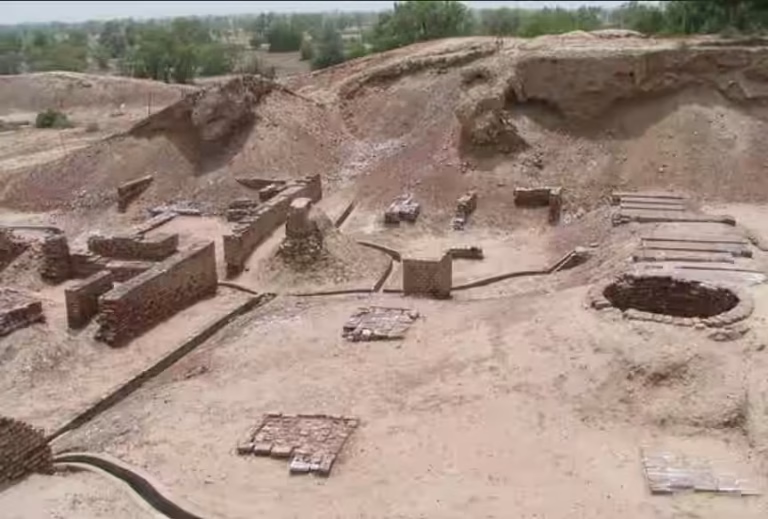
Ruins of Dholavira, Gujarat :


Lothal, Gujarat – Seemingly an inland port from IVC era. Also, Toilet and Drainage system –


Palitana Jain temple @ Bhavnagar, Gujarat Built @ 12th Century Destroyed by Islamic invasion and rebuilt again in 16th Century. Shatrunjaya is one of the most sacred pilgrimage site in Jainism.


Girnar temples @ Girnar, Gujarat Built @ 12th Century. Temple dedicated to Tirthankara Neminath – 22nd Tirthaṅkar of current civilizational cycle.


Taranga Jain temple @ Mehsana, Gujarat @ 12th Century


Balochistan – IVC’s spread was in the present region known as Balochistan named after Balochi people who are 11th Century migrant group from Iran to the region. Also, Pashtuns have nothing to with Indus Valley Civilization. The current majority tribe in Afghanistan of Pashtuns were not even present in the region of Afghanistan till their 7th Century migration to the region and continued eastwards migration towards India.
From Mehrgarh, Balochistan –


Punjab -Punjab was a region of IVC.
Harappa, Punjab –


Multan, Punjab : Punjab Parshvanath Jain temple built in early 1800s. Islamic and Sikh influence on the architecture of this 1800 A.D built structure can be seen. Ethnic Punjabi Jains – Bhabhra community of Multan migrated out to India in 1947, and the temple has been converted into an Islamic center.


Lahore, Punjab. Jain temple was demolished by Islamists with being understood as Hindu temple in 1992, and only the outside structure has been rebuilt in 2021.


Haryana – Rakhigarhi, Haryana – IVC extended to Haryana in later stages.


Maharashtra – Ellora, Maharashtra
Marathi Jains have surnames like Patil and Porwal. The Rest are NW Jains settled (not belonging to Bombay and Bombay era) in Maharashtra who are unrooted and have become like locals. The Jains in Maharashtra – Karnataka and neighboring Tamil Naidu are a mix of local ethnic converts, and migrant group from NW India who have settled over various periods. The conversion perhaps happened as these locations were on the Jain ascetic route to Shravanbela, Karnataka.
Shrikhand –> Gujarati Jain Kitchens –> Maharashtrian cuisine; Shrikhand originated as a food dish from Gujarati Jain kitchens, having a better shelf life with having the water removed from yogurt, that Jain monks could carry in their long ascetic journey.
The Ellora Jain Caves are five in number and are numbered from 30 to 34, and built around 10th Century.


Karnataka and Tamil Naidu – Karnataka was a strongly Jain influenced region. Brahmanism was violently spread by Adi Shankaracharya due to which Jain and Buddhist influence and numbers dwindled.


Bahubali at Shravanabelagola, Karnataka Built in 980 A.D. Chandragupta Maurya died through Jain Sallekhana – fast to death, over here. Maurya – A Jain convert from non Jain caste, built the greatest stretch of empire of India. His acts of violence don’t make him a Jain by his Karma and neither was his mentor – Chanakya (His family had converted to Jainism) a Jain by his Karma. Understood to be Chandragupta Maurya’s footsteps and ascetic cave, where he died.
The Jains in Karnataka are mostly left Jain by their name only and certain practices. Even the local converts had adopted Jain surname like the Marwari Jains settled in North India. Ballal surname Jains are Brahmin converts to Jainism.
Bunts – Shetty, Aishwarya Rai community originate from Sindh and accompanied Jains in their ascetic journey to South India with most converting to Jainism, after which they got probably got converted by violent conversion eras of Brahmanism pushed by Adi Shankaracharya.
Gujarati Jain kitchens –> South Indian Cuisine :: “Idada” –> “Idli”;
“Idli” is corruption of the word “Idada” (another word for Dhokla);
Batter of Idli –> Batter of Medu vada
Batter of Idli –> Batter of Dosa
Fermented + Steamed style of food preparation originates specifically from Gujarati Jain kitchens, and is an intelligent way of preparation as the fermentation makes food easier to digest. + More fermented food from similar base : Khaman, Handvo


Jharkand – Jharkand was probably another renunciation center that emerged in the past like Karnataka, to where monks left for into forested regions leaving more civilized NW India behind.
Sammed Shikharji @ Jharkhand @ 12th century


Note : I don’t own any of these pictures and they have been taken from internet through search maintaining fair use policy and that they are of known faces. If I have by mistake used a copyright image, then please contact me so that I can remove it promptly.
©2026 by CosmicWheelOfTime
One thought on “Indus valley civilization is Jain civilization”